
Stop using API keys for AI agents. Here's what replaces them.
Your AI agents are talking to each other right now.
Agent A calls Agent B. Agent B calls Agent C. Agent C calls an external API.
Every hop is an API request. How are you securing them?
If you said "API keys" or "mTLS" — you have a problem.
The mismatch nobody talks about
API keys solve one problem: authentication.
They tell you who made the call. That's it.
They don't tell you:
- What that agent is allowed to do
- How many times it can do it
- For how long
- Which other agents it can delegate to
In human systems, that's fine. Humans have approval loops. Humans are slow. Humans raise alarms when something looks wrong.
Agents have none of that.
Real examples I've seen
Example 1: A billing agent gets compromised. It calls the payment endpoint 50,000 times in 90 seconds before anyone notices. API key worked perfectly — authenticated every call.
Example 2: Agent A delegates to Agent B delegates to Agent C. Agent C's logs show a call from Agent A. No visibility into the chain. No way to audit what actually happened.
Example 3: A team spins up 50 ephemeral agents for a batch job. They use one API key for all of them. The job finishes. The key stays active for months because nobody knows which agents still need it.
What agents actually need
After building multi-agent systems for the past year, I've landed on four non-negotiable layers:
| Layer | What it does |
|---|---|
| Identity | Cryptographic proof of which agent is calling |
| Authorization | Explicit permission to call a specific action |
| Scope | Limits on count, time, and delegation depth |
| Audit | Tamper-evident trail of every decision |
API keys give you zero of these. mTLS gives you maybe the first one.
How we solved it
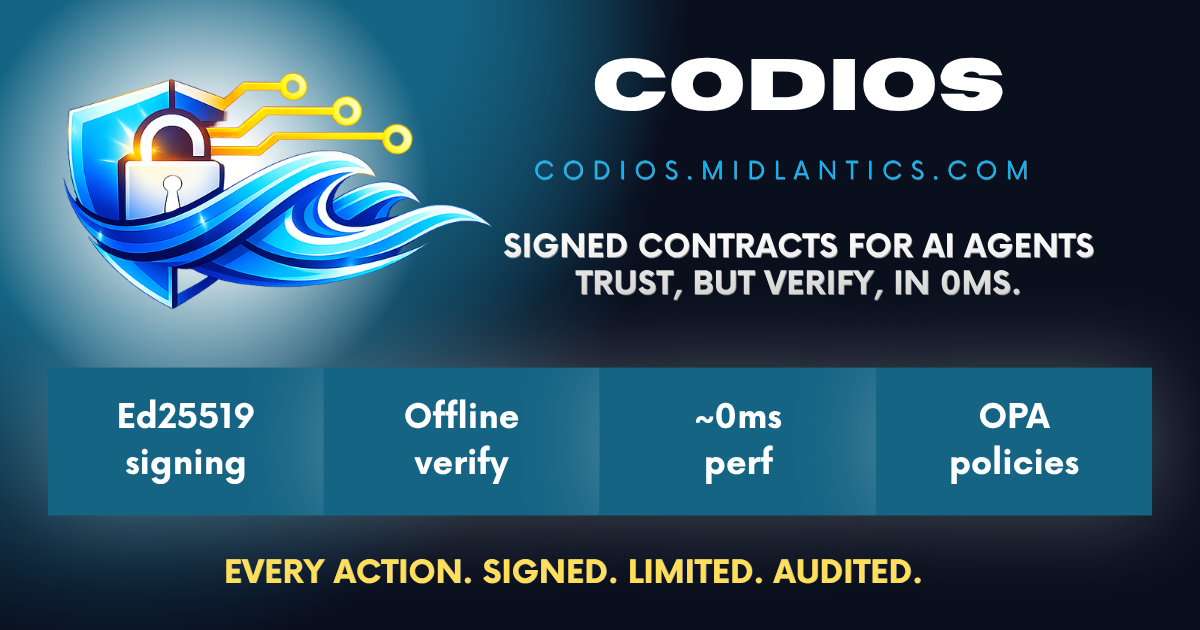
We built Codios — a cryptographic authorization layer designed specifically for AI agents.
The core idea: instead of passing API keys, agents carry signed capability contracts. A contract is a JSON document that says:
"Agent A can call the 'transfer' action on Agent B, up to 1000 times, until April 30th."
The signature is Ed25519. Verification happens offline in ~0ms. No database lookup. No network latency.
Each contract is one-time use for replay protection. Call counters prevent runaway agents. Everything is auditable end-to-end.
The whole enforcement pipeline runs in 1–2ms.
 ---
---
What you get with Codios
- TypeScript and Python SDKs with Express and FastAPI middleware
- Offline verification — no round trips for auth decisions
- Replay protection built into the contract nonce
- Audit logs that trace full delegation chains
- BYOK — your keys never leave your infrastructure
The bottom line
You can keep using API keys for agents. Many teams do.
But you'll eventually hit the same walls: delegation chains you can't trace, compromised agents you can't stop fast enough, and API keys living forever in .env files across twenty machines.
Or you can use Codios and ship today.
Building AI agents in production? Codios can be deployed as in SaaS and also as in VPC. ISO 27001 certification compliant.


